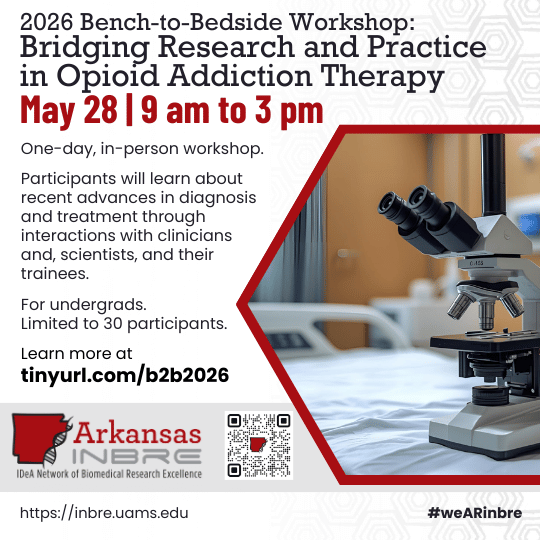
May 28, 2026 | 9 am to 3 pm
Hosted at UAMS Library Active Learning Center (ALC), 1st Floor, Education II Building
The workshop will help undergrads understand the role of translational research (bench-to-bedside) in contributing to the development of evidence-based treatments.
Do you have an interest in biomedical research? Have you ever thought about how researchers develop in-depth meaningful studies focused on addiction? Have you encountered family and/or friends with an addiction to opioids and have a desire to learn more about the disorder? Would you like to know how to help someone who has overdosed on opioids?
If you answered “yes” to one or more of these questions, we invite you to participate in a one-day workshop hosted by Arkansas INBRE at the University of Arkansas for Medical Sciences.
The day will include a keynote from Dr. Alicia Allen, Director of the National Center for Opioid Research and Clinical Effectiveness (NCOR) and roundtable discussions with basic, behavioral health, clinical, physician and translational scientists, plus a panel discussion on Graduate Program in Interdisciplinary Biomedical Sciences (GPIBS) and UAMS Graduate School.
Who can attend?
Target Audience: Undergraduate students attending College/University in Arkansas and Arkansas residents attending an out-of-state college/university.
The workshop is limited to 30 student participants. The event will take place in the UAMS Library Active Learning Center (ALC), 1st floor Education II building.
| WORKSHOP AGENDA | ||
| 9 AM | Welcome | Dr. Jerry Ware, Professor, Physiology & Cell Biology; Associate Director Arkansas INBRE |
| 9:10 AM | Overview of workshop and goals | Dr. Samantha Kendrick, Associate Professor, Biochemistry & Molecular Biology; Workshop Organizer |
| 9:20 AM | “TBD” | Dr. Alicia Allen, Associate Professor, Pediatrics, Director for the National Center for Opioid Research and Clinical Effectiveness (NCOR) |
| 10:20 – 10:30 AM | Break | |
| 10:30 AM – 12 PM | Roundtable Discussions – 30-minute rotations through each interactive group (complete 3 before lunch) | |
| Roundtable 1 | Basic/Translational Scientist: Applying behavioral pharmacology to understand biological actions of emerging drugs of abuse | Dr. William Fantegrossi, Professor, Pharmacology & Toxicology |
| Roundtable 2 | Behavioral Health Scientist – Evaluating health disparities and substance use disorder treatment trends to identify strategies to strengthen treatment services and reduce comorbidities. | Dr. George Pro, Assistant Professor, Health Behavior & Health Education |
| Roundtable 3 | Translational/Clinical Scientist: Clinical trials for intervention to optimize medication assisted treatment for opioid use disorder | Dr. Andrew James, Professor, Psychiatry |
| Roundtable 4 | Basic Scientist: Study of the neurobiological mechanisms underlying the addictive states produced by drugs of abuse | Dr. Paul Prather, Professor, Pharmacology & Toxicology |
| Roundtable 5 | Physician-Scientist: Clinical research aimed at improving reproductive safety of treatment options for neuropsychiatric illnesses including opioid use disorder during pregnancy | Dr. Shona Ray-Griffith, Associate Professor, Psychiatry; Program Director of Addiction Medicine Fellowship |
| 12 – 1 PM | Networking Lunch | |
| 1 – 2 PM | Finish Roundtables | |
| 2 PM | Panel Discussion on Graduate Program in Interdisciplinary Biomedical Sciences (GPIBS) and UAMS Graduate School | Dr. Karl Boehme, Professor & GPIBS Director Dr. Kendrick, GPIBS Track Leader Dr. Sean Taverna, Professor & Dean of the Graduate School |
| 2:45 PM | Workshop Adjourn | Dr. Kendrick |
Page updated 2/27/26